
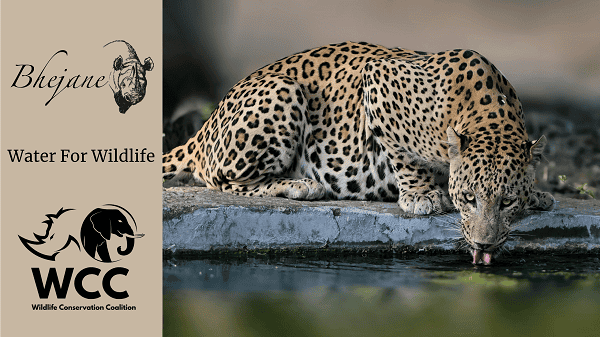
Bhejane Water For Wildlife Update – April to May 2026 The fantastic rains now seem so long ago. The season has shifted and we are most certainly well and truly into the dry months. Whilst there is still much water around, the bush has changed drastically, drying out and starting its annual die off. Our work begins in earnest as the natural water disappears and our pumped boreholes become the only drinking source for tens of thousands of thirsty animals. The teams now have full access to the area. Roads are dry, but incredibly bumpy and overgrown. The going is slow, but at least we are able to get to our pans. We are pleased to say that all our systems are mostly in order and working well. There are the inevitable issues, but fortunately these are small and quickly solvable. It is imperative that we keep water pumping into already full pans, maintaining the level rather than trying to fill them up. Whilst all signs point to this being a relatively low pressure dry period, it does not make our water work any less important. We are paying close attention to the predictions of a “super” El Nino weather system due to hit in the coming months. These drastic changes in the norm can have catastrophic implications. We remain vigilant and prepared! KAZUMA NATIONAL PARK Not much to report in Kazuma at this stage. Having received significant rain during the season it is still pretty inaccessible. However, the teams will be doing their rounds in the coming weeks as access gets easier. A few have braved the mud and the grass and ventured into this wilderness and have reported back that there is significant water still around. Water dominates the depressions, with an almost constant blanket either side of the causeway between Zimbabwe and Botswana. We have had an issue with the battery system there and it is currently not working. We hope that it is not a major issues, but is beyond our technical abilities. The experts will be heading in with our team to assess the fault and advise what needs to be done. Our fingers are crossed that it’s a simple fix as this battery system contributes significantly to corner pan. Without it, the drinking pressure is just too much. Other than that, everything else is in great working order and water is flowing into the already full pans. The herds have not yet returned, and we imagine that it will be a couple of months before they do. The grass is towering over most vehicles making visibility difficult. Animals too avoid this thick vegetation as it’s uncomfortable to move through, and makes it difficult to detect predators lurking in the undergrowth. With that said, there have been the odd special sighting of wild dogs, cheetah and leopards. Each prowling the roads in search of their next meal. The major area of work in Kazuma at the moment is fire prevention and road works. Fires are already cropping up across the landscape and have the very real potential of wiping out the ample grazing in Kazuma. Work has already begun with creating fireguards in the hope of stopping any uncontrolled burns. The rains have wreaked havoc on the road networks and much work needs to be done to get them back to a decent, drivable state. A massive shout out to Zim Parks, who have worked tirelessly on many of the access roads. Getting them passable and ready to welcome the many adventurers expected in Kazuma this year. ZAMBEZI NATIONAL PARK – CHAMABONDA Chamabonda has also been relatively quiet over the last couple of months. Whilst access is much easier, all our water infrastructure is working well. Bar a burst pipe at Thompsons Pan which was attended to swiftly, everything else is functioning at capacity and ready for the inevitable influx of elephants. The herds have slowly started to trickle in, but with abundant natural water still available the pressure is still well and truly low. Our annual clean up around the solar panels and boreholes finished up this month. With fires an imminent risk, we slash back the vegetation growth away from our infrastructure. Protection against an out of control bush fire. Wildlife sighting on the vlei are improving by the day. The big news being multiple sightings of a couple of lions around the Timots pan area. Lions generally pass through the vlei, with ad-hock sightings from time to time. This pair however seem to spend a significant amount of time in the area. HWANGE NATIONAL PARK – ROBINS & SINAMATELLA Our work has started in earnest within the Hwange Landscape. The roads have dried out sufficiently enough to allow access to much of our systems and the teams have begun their rounds to ensure that everything us functioning for the upcoming dry months. With the vast majority of our water infrastructure in Hwange, this is by far our busiest area. The big news for the period is the incredible donation received through the Beit Trust. This amazing contribution to conservation sees 4 water points becoming the proud recipients of battery backup systems. The additional power supplied through the batteries increases pumping time from 8 hours to 16 hours. Effectively doubling the amount of water supplied and greatly reducing the drinking pressure on these waterholes. Specific emphasis was been placed with the Sinamatella area, and in particular within the Black Rhino Intensive Protection Zone. As such, Tshompani Dam, Grassy Pan, Inyantue Dam and Tschantonda Pan have all received this invaluable upgrade. Team spent a full 2 weeks in the back areas erecting additional solar panels and installing the batteries. We are incredibly happy to say that this is now complete, and all is working well. A massive THANK YOU to the Beit Trust for this significant contribution to our work, and the water provision for wildlife in Hwange. The good news does not stop there. One of our greatest challenges is securing funding